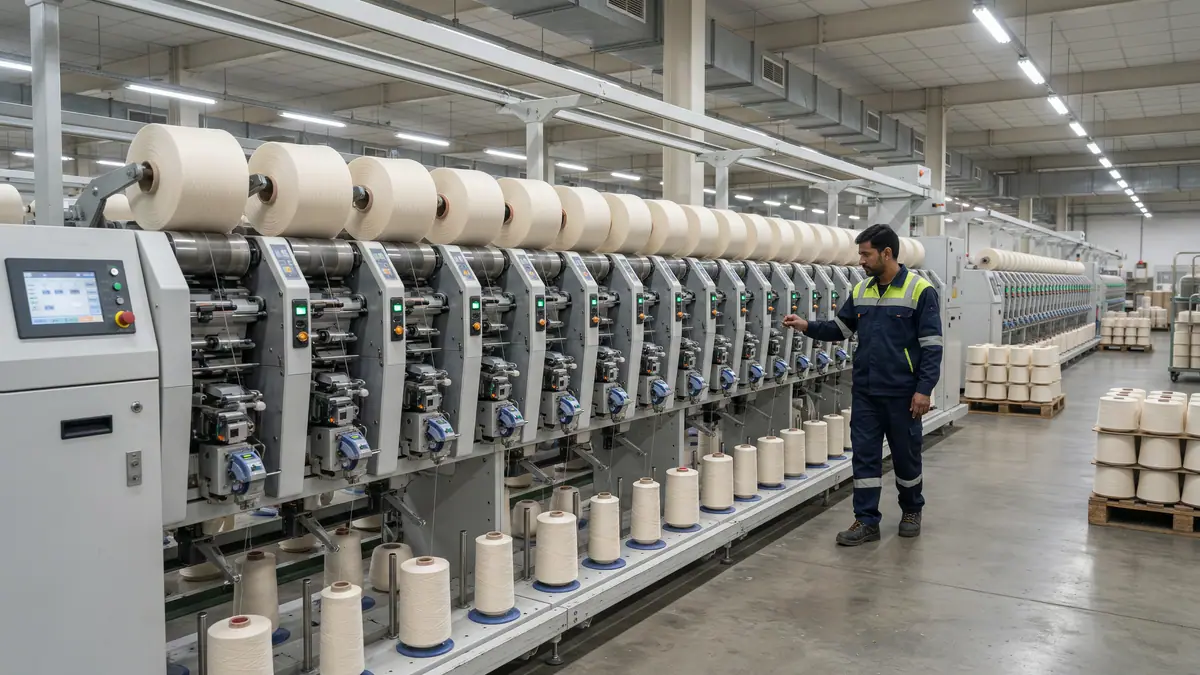
You can spin, twist, and dye the finest cotton in the world, but if the yarn is wound poorly onto its cone, it will cause sloughing, tension spikes, and constant machine stops on the buyer's factory floor. Precision yarn winding is the final quality gate that ensures every meter of yarn unwinds smoothly at high speed.
What Happens During Modern Cone Winding?
Winding is much more than transferring yarn from bobbins or dye tubes onto commercial cones. Modern automatic winding machines perform three critical quality upgrades:
- Electronic Yarn Clearing: Optical and capacitive sensors scan every millimeter of yarn in real time, automatically cutting out thick places (slubs), thin spots, neps, and foreign fibers (like polypropylene contamination).
- Air Splicing (Knot-Free Joining): Instead of tying bulky knots that jam sewing needles or leave flaws in knitted fabric, pneumatic air splicers untwist and intertwine the broken yarn ends together—creating a virtually invisible, high-strength join.
- Controlled Package Density: Precision winding lays the yarn at exact crossing angles so the cone holds its shape during shipping and unwinds cleanly without tangling or collapsing.
Soft Winding vs. Hard Winding
- Soft Winding (Perforated Cones): Used before package dyeing. Lower, uniform density allows dye liquor to circulate evenly through the entire cone.
- Hard / Precision Winding (Final Cones): Used after dyeing and finishing to create compact, high-yardage cones for weaving, knitting, and industrial sewing.
How Better Winding Saves Manufacturers Money
- Fewer thread breaks mean higher loom and sewing machine uptime.
- Consistent cone tension eliminates barre marks and fabric defects.
- Accurate meterage per cone improves inventory planning and reduces waste.
Frequently Asked Questions
Q: Why is air splicing better than knotting?
Knots are 3–4 times thicker than the yarn itself and easily snag in needle eyes or knitting hooks. Air splices retain 80–90% of the yarn's original strength with almost no extra thickness.
Q: What causes yarn sloughing off a cone?
Sloughing happens when winding tension is too low or the crossing angle is incorrect, causing multiple coils to slip off at once during unwinding.