
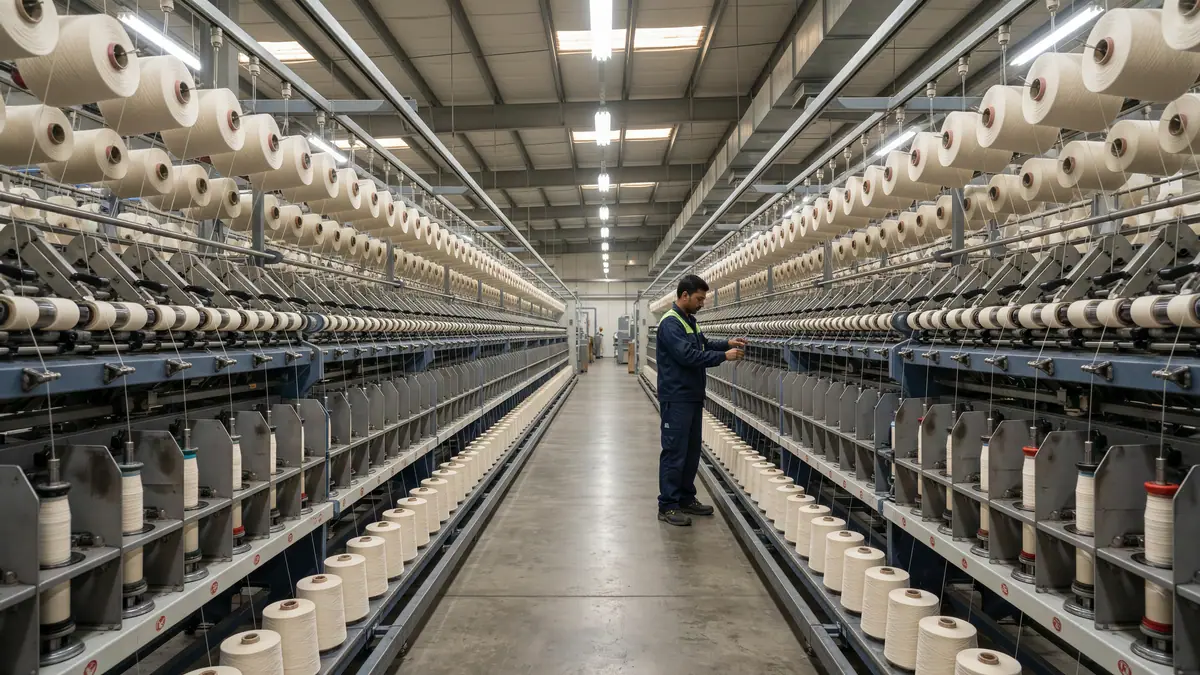
Without twist, cotton fibers are simply loose, weak strands that pull apart easily. Yarn twisting binds staple fibers together through friction, transforming delicate slivers into strong, cohesive yarns capable of withstanding commercial looms and high-speed sewing machines.
What Is TPI (Twists Per Inch)?
TPI measures how many full turns are inserted into one inch of yarn. Finding the exact right TPI is a careful engineering balance:
- Low-Twist Yarn: Softer, bulkier, and more absorbent—ideal for terry towels, knitwear, and weft yarns.
- Medium-Twist Yarn: Balanced strength and softness—standard for everyday weaving and general apparel.
- High-Twist Yarn: Dense, strong, and abrasion-resistant—essential for sewing threads, crepe fabrics, and industrial textiles. (Over-twisting, however, can make yarn brittle and prone to snarling.)
S-Twist vs. Z-Twist: Why Direction Matters
When you hold a yarn vertically, the diagonal slant of the fibers indicates its twist direction:
- Z-Twist: Fibers slant upward to the right (matching the middle bar of the letter "Z"). Most industrial sewing threads use a final Z-twist because standard lockstitch sewing machines are engineered to work with Z-twist without unraveling the thread.
- S-Twist: Fibers slant upward to the left (matching the letter "S"). S-twist is commonly used in single yarns before they are plied together in the opposite direction.
Single vs. Multi-Ply Twisting (TFO Technology)
In Two-for-One (TFO) twisting, two or more single yarns are twisted together in the opposite direction of their original spin. This creates a balanced plied yarn (such as 2-ply or 3-ply) that lies flat, resists kinking, and delivers significantly higher tensile strength and evenness than a single strand of the same weight.
Frequently Asked Questions
Q: Why does unbalanced twist cause problems in fabric?
Unbalanced twist creates internal torque, leading to "spirality" (twisted side seams in T-shirts) or snarling during winding and sewing.
Q: What is the advantage of TFO (Two-for-One) twisting?
TFO machines insert two twists for every single spindle revolution, producing knot-free, uniform packages with higher efficiency and fewer weak spots.