
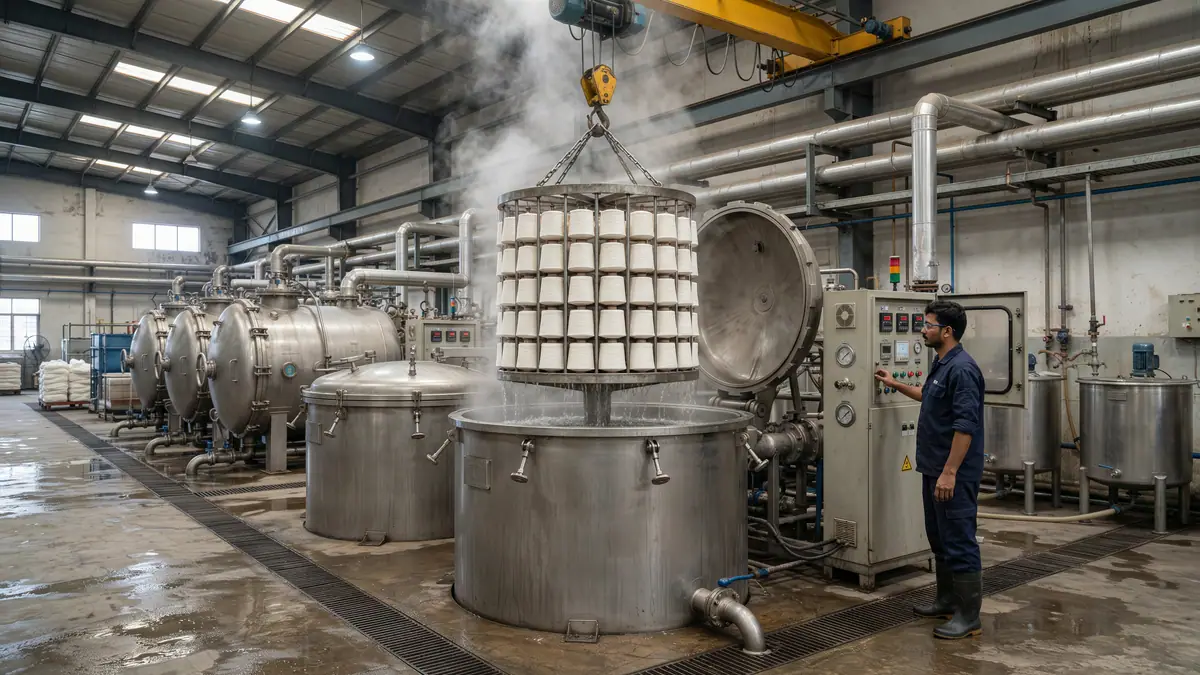
Great dyeing never starts in the dye bath—it starts in pre-treatment. Raw cotton harvested from the field contains natural waxes, pectins, seed coats, oils, and yellowish pigments. If you try to dye raw cotton directly, the natural wax repels water, resulting in blotchy, uneven color and poor fastness. Scouring and bleaching purify the yarn so it becomes uniformly absorbent and bright.
Step 1: Scouring (Deep Cleaning)
Scouring is a controlled alkaline wash (typically using caustic soda and specialized wetting/detergent agents at high temperatures). Its job is to:
- Emulsify and remove natural cotton waxes and spinning oils.
- Break down pectins and non-cellulosic impurities.
- Transform hydrophobic (water-repelling) raw yarn into hydrophilic (water-absorbing) yarn.
Step 2: Bleaching (Achieving Pure Whiteness)
Even after scouring, cotton retains a creamy, off-white tint caused by natural pigments. Bleaching oxidizes and destroys these pigments to create a clean white base:
- Hydrogen Peroxide (H₂O₂) Bleaching: The modern, eco-friendly industry standard. It decomposes cleanly into water and oxygen, delivers permanent whiteness without yellowing over time, and is gentle on cotton fibers.
- Optical Brightening Agents (OBAs): For "super-white" or optic-white yarns, fluorescent whitening agents are added to absorb UV light and emit a crisp blue-white glow.
Why Pre-Treatment Determines Final Product Quality
- Level Dyeing: Perfectly scoured yarn absorbs dye evenly from the core to the surface.
- True Pastel Shades: Light pinks, baby blues, and ivories require a pure bleached base so natural yellow tones don't muddy the color.
- Preserved Fiber Strength: Careful pH, temperature, and peroxide stabilizer control ensure impurities are removed without causing chemical tendering (weakening) of the cotton.
Frequently Asked Questions
Q: Can scouring and bleaching be combined into one step?
Yes. Modern textile processing often uses a combined one-bath scouring and peroxide bleaching process, which saves water, energy, and processing time while maintaining high absorbency.
Q: How is scouring quality tested?
Labs perform a drop absorbency test: a water droplet placed on properly scoured cotton yarn should absorb completely in under 1–3 seconds.